30 tips for bidding on a house in the Netherlands in 2026
You want the house, and you don't want to pay too much. These tips for bidding on a house in the Netherlands cover
everything around your offer: what to look up beforehand at the Land Registry (Kadaster) and the municipality,
what to look out for at the viewing, what to ask the estate agent (makelaar) and how to make your offer stronger without bidding higher.
Each tip is short and has a source. Most sources are Dutch websites. How much to bid is explained in how much to bid on a house.
The sooner you see a house, the sooner you get a viewing. So set up a saved search, for example on Funda (the main Dutch listing site), and you see new listings straight away4. With Home Alert you get the homes that fit you every evening.
2Ask how long the house has been for sale
In the third quarter of 2026, a house was on the market for 31 days on average2. Has it been for sale longer, or did the asking price go down? Ask the agent why. The longer a house is for sale, the more time you have to compare and negotiate2.
3Ask for the documents before you view
The seller gives you an energy label, which is required by law5. Also ask for the seller's questionnaire about the house (vragenlijst) and the list of items that stay or go (lijst van zaken). Then you already know what to look out for at the viewing.
Buying an apartment? Then also ask for the documents of the owners' association (VvE): the maintenance plan, the minutes of the latest meetings and how much is in the reserve fund. A VvE puts money aside every year for major maintenance6. If that fund is empty, you pay your share later.
4Look up the WOZ value, of the neighbours too
The WOZ value is the official value the municipality sets for every home. In the WOZ-waardeloket (in Dutch) you can see the WOZ value of every house for free, so also of the houses next door7. Note that this value is based on 1 January of the previous year7. It is a guide, not an offer. How to choose an amount using sales in the neighbourhood is explained in how much to bid on a house.
5Get the sale prices in the street from the Land Registry
The Land Registry (Kadaster) shows what houses in your postcode area have sold for since 2003, with the date and plot size. That costs €3.70 per postcode. You can also ask per address by text message: send KOOPSOM with the postcode and house number to 8118, for €1.508.
6Check what is registered on the house
With the ownership information from the Land Registry you see who the owner is, which rights and restrictions apply and whether there is leasehold (erfpacht). The mortgage information shows which mortgages and seizures are registered on the house9. If there is a large mortgage on it, the seller often has little room to lower the price10.
What you can request from the Land Registry
Sale price informationSale prices in the postcode area
€3.70
Ownership informationOwner, rights and restrictions, leasehold
€3.70
Mortgage informationMortgages and seizures on the house
from €3.70
Property reportPrices of similar houses and the energy label
€21.50
Prices according to the Land Registry, October 20269.
7Check leasehold and the zoning plan
With leasehold, the house is yours but the land belongs to someone else, usually the municipality. You then pay an annual ground rent (canon), and it can go up after a set period. The bank counts the ground rent, so you can borrow less11.
What may be built around the house is shown in Regels op de kaart (in Dutch) in the Omgevingsloket, the government's planning portal. It shows the environment plan (omgevingsplan) and the old zoning plans (bestemmingsplannen)12.
8See how the neighbourhood scores
The government's Leefbaarometer (in Dutch) gives neighbourhoods a score for the surroundings, the houses, amenities, how people get along, and nuisance and safety13. That way you know how the neighbourhood is doing before the viewing.
9Check the risk of foundation problems
Around half a million houses in the Netherlands have subsided. Houses built before 1970, houses on wooden piles, and houses on peat or clay are at greater risk. The map of the KCAF, the Dutch knowledge centre for foundation problems, shows the risk per town. If in doubt, have a foundation survey done. That costs a few thousand euros14.
Warning signs at the viewing
Cracks in the walls
Sloping floors
A height difference between the house and the pavement
Doors or windows that stick
One sign does not mean there is damage. In a risk area it is a reason to ask more questions14.
10Watch for asbestos in houses built before 1994
Since 1994, asbestos may no longer be used in houses. If the house is older, it can still be in the roof of the shed or garage, around the central heating boiler, behind the kitchen units, in the crawl space or under old floor covering. If in doubt, have an asbestos survey done15. Removal costs money, so include it in your offer.
11Bring someone with a critical eye
Ideally, bring someone who knows about building. Together, look for damp, the roof, the window frames and cracks in walls and floors. If you spot something, you know which questions to ask and whether you want a building inspection (bouwkundige keuring).
12Bring a tape measure and a marble
View the house in daylight, so you can see small cracks better. Measure whether your furniture fits and put a marble on the floor: if it rolls away, the floor may be sloping. Test the taps and the toilet, and take photos if the agent agrees16.
Level floorSloping floor If the marble keeps rolling the same way, ask more about the floor and the foundation.
13Ask why the seller is moving
Has the seller already found another house, or do they want to leave later? Then you know which handover date matters to them. For sellers, conditions sometimes weigh as heavily as the price17. More on this in the tips for a sealed-bid sale.
14Ask about known defects
If the seller knows of a defect that gets in the way of normal use of the house, they must tell you. Defects you can see yourself, you are expected to investigate yourself18. So keep asking, and put the answers in your email after the viewing.
15Ask about the running costs
Ask about the energy use, the VvE contribution (the monthly service charge for an apartment) and the ground rent for leasehold. Together they decide what the house costs you each month, on top of your mortgage. The bank also counts ground rent when it works out how much you can borrow11.
Take this list to the viewing
Ask the agent
Since when has the house been for sale?
Why is the seller moving, and when do they want to leave?
Are any defects known?
What stays behind in the house?
What does the house cost per month in energy, VvE and ground rent?
How many viewings have there been, and are there already offers?
How does the bidding work, and is there a deadline?
Check yourself
Damp and mould in the cellar, bathroom and corners
Roof, gutters and window frames
Cracks in walls and floors
Age of the central heating boiler and the fuse box
Noise from the street, neighbours and railway
Parking, and the street at a different time of day
16Have a chat with the neighbours
Neighbours often know useful things about the area16. For example, ask how parking works, whether there is any nuisance and whether there is subsidence in the street.
17Plan a second viewing
Come back at a different time, for example in the evening or at the weekend. Then you see how the light falls and how busy the street is. There is room for that now: 24% more houses are for sale than a year earlier2.
18Remember who the agent works for
The selling agent (verkopende makelaar) works for the seller19. So don't say the most you can pay, and don't show too much enthusiasm. That gives the agent room to push up the price20. Want someone on your side? That is a buying agent (aankoopmakelaar), see bidding advice or a buying agent.
19Ask how much interest there is
Ask how many viewings there have been and whether there are already offers. You will not hear the amounts others offered19. What the agent may and may not tell you is explained in bidding with multiple interested buyers.
20Ask which bidding method the agent uses
Can you negotiate, or is the house sold by sealed bid (inschrijving)? And is there a deadline? In a sealed-bid sale you get one chance, when negotiating you get more rounds21. The four methods are listed in bidding on a house.
21Negotiating? Confirm everything by email
A verbal agreement is not yet a sale. The sale is only fixed once you both sign the purchase agreement (koopakte), after which a private buyer has a three-day cooling-off period2217. If you negotiate with the agent, confirm your offer and every agreement by email, with an expiry date. In a sealed-bid sale you submit your offer through the bidding form. It is then already recorded in the bid log (biedlogboek)23.
22Have the building inspection done before you bid
At the end of 2025, 55% of buyers made an offer without a condition for a building inspection24. Want to do the same? Then have the house inspected before you bid. That way you know what is going on and you meet your duty to investigate (onderzoeksplicht) as a buyer18. If you do bid with a condition, read what goes in an offer.
23Include the renovation in your offer
Want a new kitchen, a bathroom or a dormer window? Add those costs to your offer. If you offer €400,000 and renovate for €40,000, the house costs you €440,000 plus buyer's costs (kosten koper, such as transfer tax and notary fees).
A renovation that makes the house worth more, such as a dormer or an extension, you can fully include in your mortgage. A kitchen or bathroom to your own taste only partly25.
24Use a construction deposit
You can borrow up to 100% of the value after the renovation, if a valuer (taxateur) sets that value in a valuation report. The money for the renovation goes into a construction deposit (bouwdepot). The bank pays your contractor's bills from it, and whatever is left goes towards your mortgage25.
Want NHG (the Dutch national mortgage guarantee)? Then your mortgage in 2026 can be at most €470,000, or €498,200 with energy-saving measures26.
Calculator: what does this house really cost you?
Enter your own amounts. The example amounts are already filled in.
Offer plus renovation
€440,000
Mortgage (up to 100% of the value after renovation)
€430,000
Of which in the construction deposit
€30,000
Transfer tax
€8,000
Own money needed
€23,000
Offer plus renovation is €10,000 more than the value after renovation. You pay that difference yourself, as you do the buyer's costs.
Transfer tax (overdrachtsbelasting) is 2%. If you are 35 or younger and the house is worth at most €555,000, you pay nothing, subject to conditions27. You pay the buyer's costs from your own money28. Your income also decides how much you can borrow, so ask your mortgage adviser to work it out with you. This is an example, not advice.
25Limit your financing condition to what you borrow
A financing condition (voorbehoud van financiering) lets you cancel the purchase without a penalty if you don't get your mortgage3. Don't want to bid without one, and do you have savings to put in? Then let the condition apply only to the amount you borrow20. The seller then sees that your own share is there no matter what. In Move, the online bidding system many agents use, you also enter the amount of your condition with your offer29.
Example: you offer €400,000 and put in €60,000
€60,000 own money falls outside the condition
€340,000 mortgage subject to the financing condition
In your offer: subject to financing up to €340,000
If you bid with no condition at all and can't get your mortgage, backing out of the purchase usually costs 10% of the purchase price3.
26Have your adviser confirm your financing
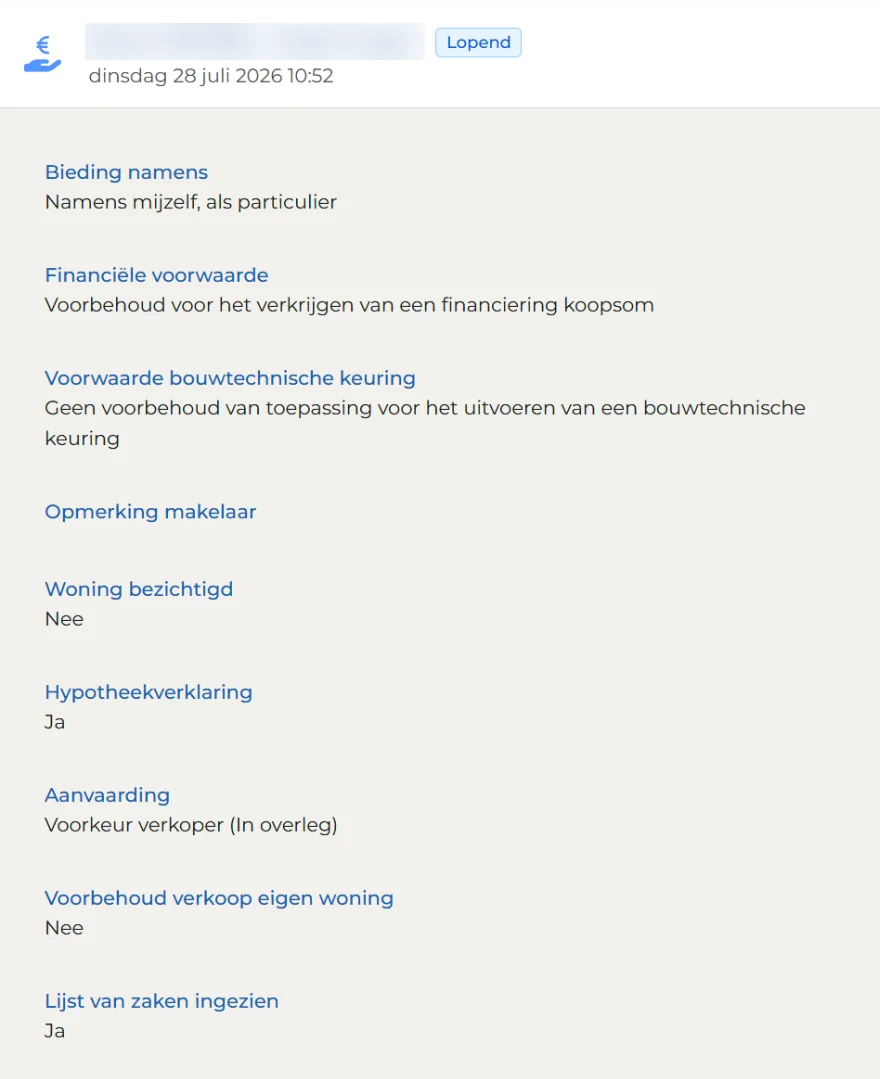
Send a statement from your mortgage adviser (hypotheekadviseur) with your offer, with the amount you can borrow according to their calculation. Add their phone number, so the seller can check it30. In Move you state with your offer whether you have a mortgage statement (hypotheekverklaring).
An offer by Dion in Move, with "Hypotheekverklaring: Ja" (mortgage statement: yes). Amount and address have been blurred. Move is in Dutch.
27Write a short, clear letter
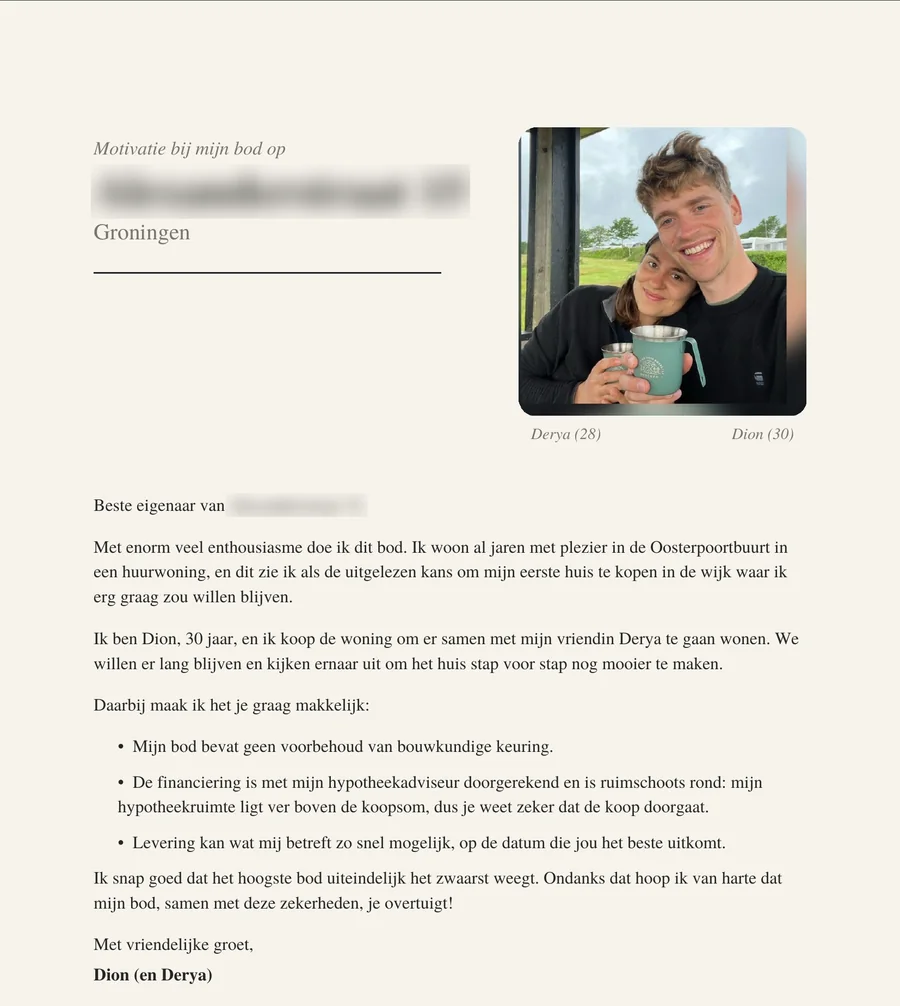
A few sentences about who you are and why you want this house help when the offers are close together31. You will find an example under the motivation letter with your offer.
The letter Dion sent with his offer, in Dutch, with the address blurred.
Tip from Dion
Leave nothing to chance: always write a short, clear letter.
Dion Smits, co-founder
28Get a bidding advice report
For one address, the report works out how likely you are to get the house at every amount, using at least five sales from the neighbourhood. Then you bid on figures instead of on gut feeling. It costs €24.95 and opens on the website straight after payment.
Bidding advice report €24.95
What should you bid on this house?
The report works out per address how likely you are to get the house at every amount, backed by at least five sales from the neighbourhood. After payment your report opens straight away on the website.
Example: your offerChance of getting the home
€352,33130%
€361,68750%
€372,16370%
€388,24390%
From the report for Karel Doormanlaan 378 in Hilversum: asking price (vraagprijs) €350,000, expected sale price €361,687. View the sample report
{{ loadingMsg }}
Which bid gives you the best chance?
Paste the Funda link or search by address. Then pay and see your report straight away.
Your relation to the property
{{ selected.label }}
{{ opt.label }}
Checkout
After payment your bidding advice opens straight away on the website.
Bidding advice report{{ selected.label }}
€24.95
✓Your chance of getting the home at every bid
✓The expected selling price
✓At least five sold homes nearby, with sale price
Filled in from your account. Want to use a different address?
Sign out first.
You'll use this to find your report later.
This is not a valid email address. Enter a valid email address to pay.
Tick this checkbox to pay.
Pay securely with iDEALNot satisfied? Money back
{{ status.message }}
Property details
{{ selected.label }}
{{ woningErr }}
Additional property details
The more information we have about the home, the better the bidding advice.
Bidding deadline
{{ selected.label }}
{{ status.message }}
Your request for {{ selected.label }} is ready above.
Write down your maximum before you start bidding, and stick to it. Missing out on a house feels bad. An offer that is too high, you pay off for years. You may bid on several houses at the same time32, so this house is not your only chance.
Tip from Dion
Don't bid on emotion alone.
Dion Smits, co-founder
30Don't treat the asking price as fixed
Of all sales, 24% went below the asking price and 8% at exactly the asking price1. It differs a lot per municipality: in Terneuzen 35% sold above the asking price, in Utrecht 93%1. So look at sales in the neighbourhood, and not only at the asking price. How that works is explained in how much to bid on a house.
Where the sale price ended up compared with the asking price
24% below the asking price
8% exactly the asking price
69% above the asking price
All sales from July 2025 to June 2026, calculated by Biedadviseur1. Because of rounding the total is 101%. The figures per municipality are in overbidding per municipality.
Frequently asked questions
Questions about bidding on a house in the Netherlands
Does the seller have to tell you about defects?
+
Yes, if they know of a defect that gets in the way of normal use of the house. Defects you can see yourself, you investigate yourself. A building inspection (bouwkundige keuring) helps you with that18.
Can you include a renovation in your mortgage?
+
Yes, up to 100% of the value after the renovation, if a valuer sets that value. The money sits in a construction deposit (bouwdepot) and the bank pays your contractor from it. A kitchen or bathroom to your own taste can only be partly financed25.
What is a financing condition up to an amount?
+
A condition that only applies to the part you borrow. If you offer €400,000 and put in €60,000, the condition applies up to €340,00020. If you don't get that mortgage, you cancel the purchase within the agreed period without a penalty3.
Can you view a house more than once before you bid?
+
You can always ask the agent. Now that houses are on the market for longer, there is more often room for a second viewing2.
Can you bid without seeing the house?
+
You may. You do have a duty to investigate: a defect you could have seen at a viewing is hard to claim from the seller later18.
How much transfer tax do you pay in 2026?
+
2% of the purchase price if you will live in the house yourself. If you are 35 or younger and the house is worth at most €555,000, you pay nothing, subject to conditions27.
About this page
Who wrote this, and where the information comes from
We were both looking for a house and got stuck at the same moment: the offer. A buying agent felt too
expensive, and as if agents were arranging things among themselves. Read our story.
Niek
Data scientist (MSc) · co-founder
Niek spent ten months on the calculation model behind every report. He calculated the asking price figures on this page.
Updated on . This page gives tips for bidding on a house and is not legal or financial advice.
Sources (32)
+
Asking price and sale price: Biedadviseur.nl's own calculation, the sale price compared with the last asking price for transfers at the notary from July 2025 to June 2026. Explained in how much to bid on a house.
Hypotheker, Woningkopers krijgen meer keuze en ruimte om te onderhandelen (in Dutch, 12 October 2026, based on NVM figures for the third quarter): on the market for 31 days on average against 29 a year earlier, 24% more houses for sale, and more room to compare, plan a second viewing and negotiate. The NVM is the largest Dutch association of estate agents.
KNB, Een huis kopen. Hoe werkt dat? (in Dutch, October 2025): conditions, cancelling without a penalty under a condition, and the penalty of usually 10% if you back out of the purchase without a valid condition.
Kadaster, Koopsominformatie (in Dutch): sale prices of homes in a postcode area since 1 January 2003 for €3.70, or per address by text message for €1.50.
Kadaster, Informatie over je nieuwe woning (in Dutch): ownership information (€3.70), sale price information (€3.70), mortgage information (from €3.70) and the property report (€21.50).
Hypotheker, Een woning kopen met erfpacht (in Dutch, April 2022): the land belongs to someone else, you pay an annual ground rent that can change after a set period, and with ground rent you can borrow less.
Radar, Fundering bijna nooit vermeld bij koopwoning (in Dutch, March 2024): around half a million subsided houses, which houses are at greater risk, the KCAF map, warning signs at the viewing and the cost of a foundation survey.
Univé, Asbest in je woning (in Dutch): asbestos in house building has been banned since 1994, where it is often found in older houses and the advice to have a survey done if in doubt.
Knab, Huis bezichtigen: checklist en tips (in Dutch, January 2026): view in daylight, tape measure, marble, photos with permission, test the taps and toilet and meet the neighbours.
NVM, Bieden op een huis (in Dutch): conditions are sometimes as important to sellers as the price, and after a verbal agreement the seller can still accept a higher offer.
Rechtspraak, Verborgen gebreken (in Dutch): the seller reports defects they know of that hinder normal use, the buyer investigates visible defects themselves, and a building inspection helps with that.
NVM, appendix to the Erecode (in Dutch): the agent acts for their client, treats all buyers equally and does not share information about other people's offers.
Hypotheek.nl, Slimme tactiek bieden huis: 9 tips (in Dutch, 9 July 2026): a financing condition up to the amount you borrow, with a worked example, and not showing your enthusiasm to the selling agent.
NVM, Protocol Transparant Bieden Woonruimte (in Dutch, mandatory for NVM agents since 1 February 2026): the bidding methods, from negotiating to a sealed-bid sale with a bidding deadline.
Hypotheker, Verbouwing meefinancieren (in Dutch): borrowing up to 100% of the market value after renovation with a valuation report, in full for a renovation that adds value, partly for a kitchen or bathroom to your own taste, and how a construction deposit works.
Funda, Succesvol bieden bij een inschrijving (in Dutch, April 2023): Vereniging Eigen Huis (the Dutch homeowners' association) and an NVM agent on conditions, the seller's preferred handover date and the goodwill factor.
Juridisch Loket, Bod op huis (in Dutch): you may bid on several houses at the same time, and your offer lapses after its expiry date.
What should you bid on the home you want?
Paste the Funda link or type the address. You see your chance of getting the home at every amount, backed by sales from the neighbourhood.